Is your sunscreen pilling? 7 steps to prevent pilling
Your serum has settled, your skincare has absorbed—but as soon as you apply sunscreen on top, small rolls form on your skin? This so-called pilling is especially annoying in late summer: Your skin should be reliably protected while your makeup should look smooth. The small crumbs do not automatically mean that a product is bad. Often, too many layers, overly large amounts of product, vigorous rubbing, or formulations that do not work well together are involved.
The most important rule is: Do not skimp on the necessary amount of sunscreen. If sunscreen pills, simplify the routine underneath and adjust the application technique—not the level of UV protection.
What does pilling mean with sunscreen?
Pilling describes the small rolls or crumbs that form when spreading skincare, sunscreen, or makeup. Usually, it is the product film rolling off; it is not automatically flakes of dry skin. Some film-forming ingredients, thickeners, silicones, powders, or rich oil phases can interfere with one another in multiple layers of formulations. A still-damp layer underneath can also come loose again when rubbed.
Pilling and a white film are not the same thing. A so-called white cast is mainly caused by some mineral UV filters and remains visible as a light veil. Pilling, on the other hand, forms individual little rolls that come off under your fingers or when applying makeup.
Sunscreen without pilling: the 7-step routine
1. Start with clean, dry skin
Gently cleanse your face in the morning and pat it dry. Residue from rich night cream, oil, or a sleeping mask can affect how well the next layers adhere. Your skin does not need to feel squeaky clean; harsh cleansing or hot water can unnecessarily irritate the skin barrier.
2. Simplify your morning routine to the essentials
More layers mean more potential points of contact. Toner, essence, two serums, facial oil, moisturizer, primer, and sunscreen are not automatically more effective than a simple routine. In the morning, cleansing, a suitable serum or lightweight moisturizer, followed by sunscreen, are often enough. Active ingredients can be moved to the evening if needed.
3. Use small, even amounts under sunscreen
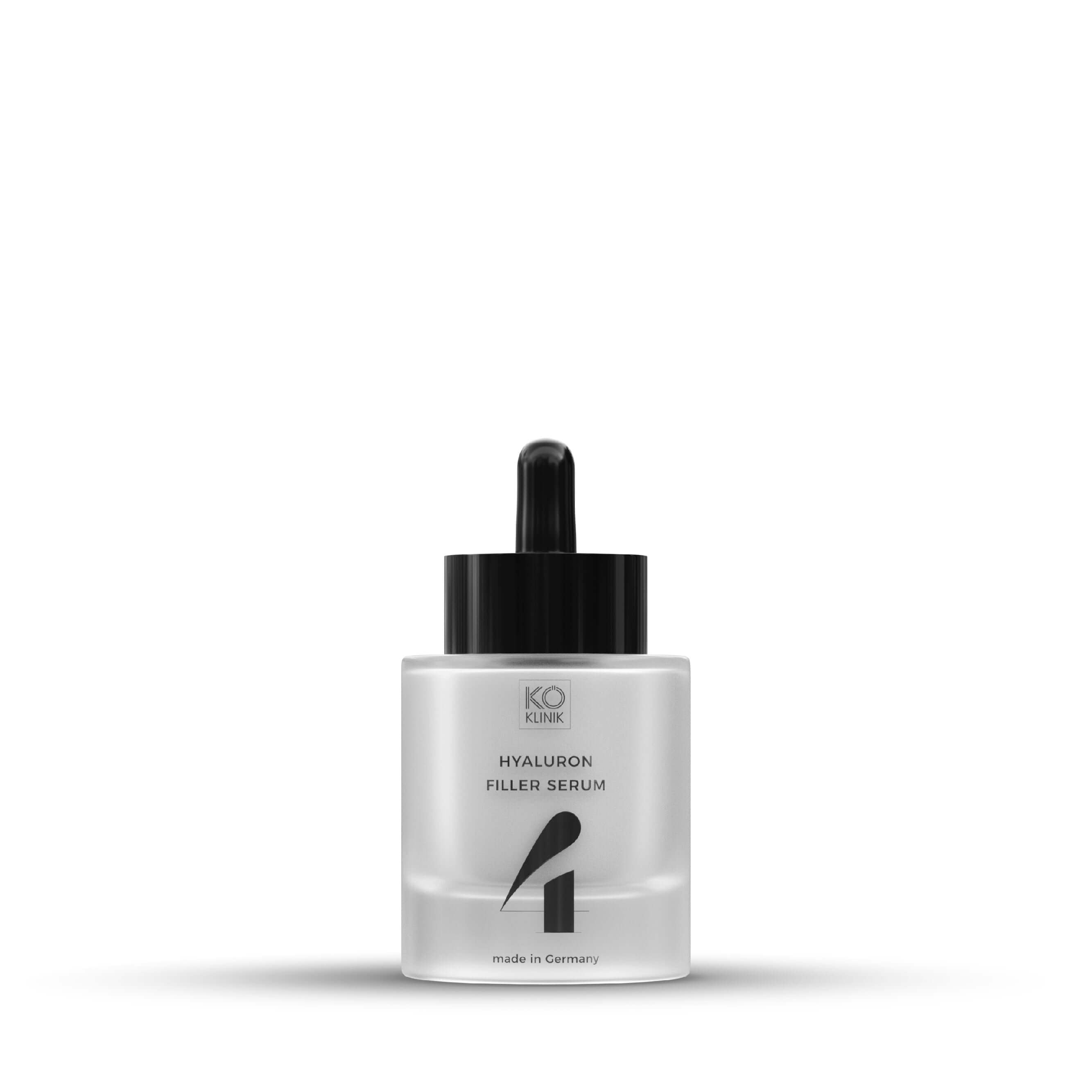
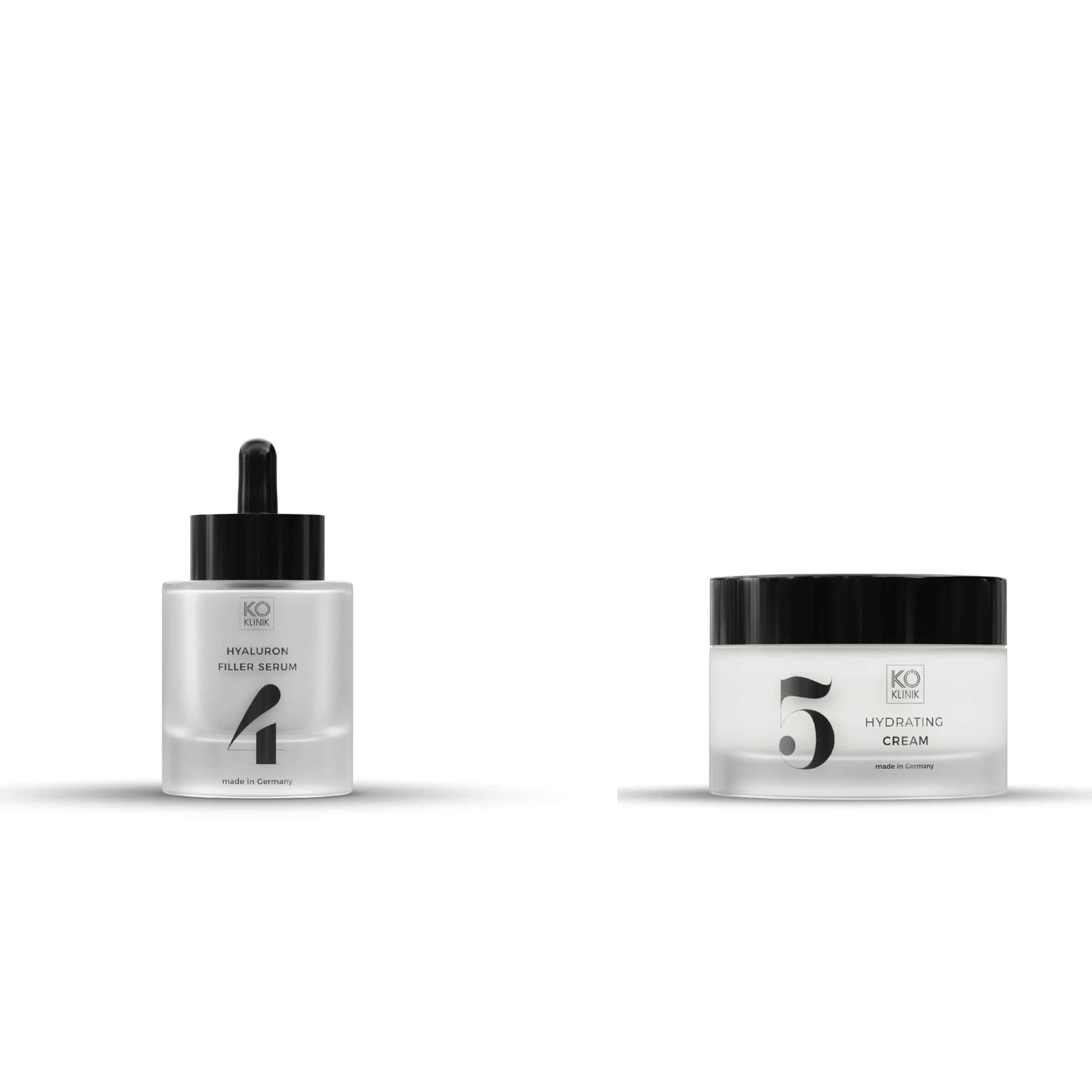
A thin layer is usually sufficient for serum and cream. The KÖ KLINIK Hyaluron Filler Serum can be applied as a lightweight hydrating step. Apply a few drops to slightly damp skin and let the serum absorb. If your skin still needs a cream afterward, choose a small amount and spread it evenly. The KÖ-KLINIK Hydrating Cream is one possible cosmetic moisturiser; whether it works well with your personal sunscreen should be tested in practice.
Important: The amount limitation applies to the skincare under the sunscreen. For SPF, follow the product's instructions and apply a sufficient amount.
4. Allow each skincare layer to set
The next layer should not be applied to a surface that is still wet and slippery. Wait until the serum or cream is no longer noticeably sticky and the skin feels even. There is no need for a rigid ten-minute rule—formulation, amount, skin type, and room climate determine the timing. If you have little time in the morning, you can brush your teeth or do your hair between skincare and SPF.
5. Apply sunscreen as the final skincare step
The American Academy of Dermatology recommends applying sunscreen after other skincare products and under makeup. Choose a broad-spectrum, water-resistant sunscreen with at least SPF 30 and follow the manufacturer's instructions. Sunscreen is not a primer that should be reduced to a very thin amount. Remember your ears, neck, hairline, and décolleté too—our guide to décolleté care in late summer complements the routine.
6. Spread section by section instead of rubbing endlessly
Apply the sunscreen in a controlled manner to your forehead, cheeks, nose, chin, and neck. Spread it evenly using short, gentle movements. Once the film has settled, do not keep rubbing over it. Vigorous rubbing can mechanically roll the polymers and product films underneath into flakes. With sensitive combinations, gently patting may work better than circular massaging.
7. Identify the problematic combination systematically
If pilling persists, test the products individually. One morning, use the sunscreen on clean, dry skin without any other skincare. If that works, add only the serum the next day, followed by the cream if necessary. This helps identify which combination is causing problems. Always change just one factor—amount, order, or product—instead of replacing the entire routine at once.
How much sunscreen is right?
The sun protection factor stated on the packaging is achieved only when enough product is used. The AAD recommends at least about a teaspoon for the face, or approximately the length of the index and middle fingers; the amount needed may vary depending on the product instructions and whether the neck is included. Follow the manufacturer's dosage instructions and reapply outdoors approximately every two hours and after swimming or heavy sweating.
If a sufficient amount pills regularly, that is a sign to change the skincare underneath or the specific sunscreen—not to reduce the amount so much that nothing rolls off but the protective film becomes too thin.
What should you do if the sunscreen is already pilling?
- Do not keep rubbing: This often removes even more of the product film and possibly some sunscreen as well.
- Carefully remove loose rolls: Do not rub over the entire area of skin.
- Assess the protective film: If large areas look patchy or rubbed off, it is better to rebuild the routine.
- Simplify when starting over: Clean, dry skin, just one lightweight skincare layer, and then sufficient SPF.
- Apply make-up afterward: Wait until the sunscreen film has set, then gently press on make-up.
These pilling mistakes are especially common
- Layering too many products: Each additional film increases the risk that the formulations will not work well together.
- Applying oil directly under sunscreen: Rich oil films can make some SPF textures seem unstable.
- Not allowing serum and moisturizer to absorb: Still-damp layers are displaced during the next application.
- Massaging for too long: Constant rubbing mechanically rolls off the product film.
- Using less sunscreen: This may conceal pilling, but it can reduce protection.
- Applying make-up immediately afterward: Brushes and sponges can lift a film that has not yet set.
- Exfoliating as a quick fix: Pilling is often caused by the product film, not insufficient exfoliation. Exfoliating too frequently can cause irritation.
Make-up over sunscreen: how to keep the film smooth
Let the sunscreen set for a few minutes before applying foundation or concealer. Apply makeup in thin layers and gently press it on with a clean sponge or dense brush instead of repeatedly dragging it across the skin. Use powder only where it is really needed. If primer, foundation, and SPF pill together, first test whether the primer can be omitted.
Pilling or skin irritation?
Product rolling is usually a cosmetic compatibility issue. Burning, persistent redness, swelling, itching, or a rash, on the other hand, may indicate irritation or an intolerance. In that case, gently wash off the product and stop using it until the cause has been clarified. For severe or persistent symptoms, dermatological advice is advisable.
Frequently asked questions
Is pilling always caused by silicones?
No. Silicones may be involved, but thickeners, film-formers, powders, oils, excessive amounts, and application technique can also play a role. The specific combination of formulations is what matters.
Should sunscreen go before or after moisturizer?
In a classic morning routine, sunscreen comes after serum and moisturizer and before makeup. For combination products and medically recommended products, follow the respective manufacturer's or physician's instructions.
Does waiting longer always prevent pilling?
Not always. Waiting helps if a layer is still too wet. If two formulations are fundamentally incompatible or too much skincare was applied underneath, the problem may persist.
Can I simply brush off pilling sunscreen?
Vigorous brushing can make the protective film uneven. If a noticeable amount of product comes off, rebuilding a sufficient layer is more reliable.
Conclusion: Simplify your routine without reducing protection
When sunscreen pills, three things usually help: fewer layers underneath, enough time between products, and less friction during application. Test combinations systematically and maintain adequate sun protection. This keeps your morning routine smoother—without compromising UV protection.
Expert guidance: American Academy of Dermatology: How to apply sunscreen, updated on August 15, 2025; AAD: Order of skincare, sun protection, and makeup. As of August 28, 2026.